
Paper Lots vs. Real Value: Why Smart Master Planning Drives Developer ROI
In land development, spreadsheets can be deceiving.
When evaluating rural or suburban tracts across Texas, the first instinct is often to maximize yield on paper like tighter lot widths, higher unit counts, and aggressive layouts that push density to the limit. In theory, more lots equals more value.
But seasoned developers know the reality is more complicated.
Paper lots do not always translate to real performance. Communities succeed not just because of how many homes fit on a site, but because of how well those homes respond to the market, the land, and the lifestyle buyers are seeking.
Today, the most successful master-planned communities in Texas are not those that simply maximize density. They are the ones that balance yield with product diversity, amenities, and long-term livability. This ultimately increases absorption and delivers stronger returns.

The Difference Between Yield and Performance
Yield is an important metric in development underwriting. It drives financial modeling, land valuation, and entitlement strategy. But yield alone does not determine a project’s success.
Developers and builders must consider several other factors that influence real world performance:
Lot widths that align with builder product lines
Absorption rates tied to realistic market demand
Amenity placement that creates premium lot value
A mix of housing products that serve multiple buyer segments
If these elements are not coordinated early in the planning process, a site may technically fit via the pencil, yet struggle once it reaches the market.
Communities that focus solely on lot count often face slower absorption, reduced buyer interest, and pressure to discount pricing. Conversely, developments designed around a strategic mix of products and experiences tend to outperform their projections.
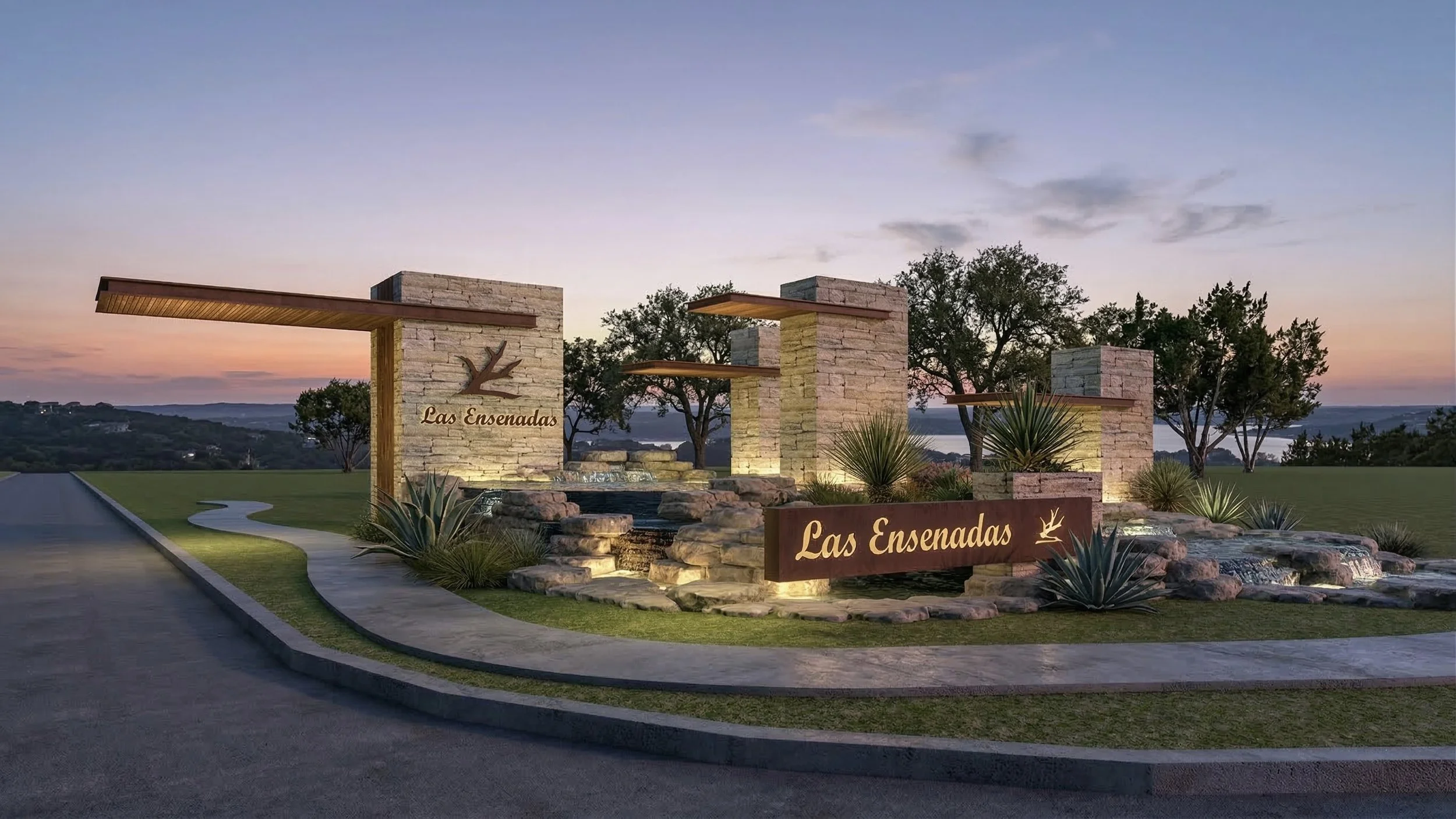
Las Ensenadas Entry Monumentation
Las Ensenadas: Planning for Lifestyle and Value
A strong example of this strategy can be seen at Las Ensenadas on the north shore of Lake Travis near Austin.
Set on nearly 80 acres of Texas Hill Country landscape where two deep water coves meet, the community takes a different approach from traditional suburban subdivisions. Instead of focusing solely on lot quantity, the plan prioritizes experience, views, and lifestyle amenities that enhance the value of each homesite.
Las Ensenadas features just over 50 estate homesites (each typically over an acre) paired with resort level amenities including private lake access, a floating multi-level boat club, a lakefront infinity pool, trails, and recreational spaces designed around the natural landscape.
This model demonstrates an important principle in land development: value can come from the quality of the environment, not simply the quantity of lots.
By creating a lifestyle-driven community with distinctive amenities and natural character, the project increases the desirability of each homesite, which allows developers to capture value in ways that pure density cannot.
Designing for ROI, Not Just Lot Count
Ultimately, the goal of master planning is not simply to divide land into parcels. It is to create environments where market demand, land characteristics, and community design reinforce one another.
The most successful projects align several disciplines early in the process (land planning, architecture, landscape architecture, and amenity programming) to ensure the community functions both economically and experientially.
When done correctly, this integrated approach can:
Increase lot premiums through amenity adjacency
Improve absorption through product diversity
Strengthen long-term property values
Reduce costly redesign during entitlement or construction
In other words, thoughtful planning does more than organize land, it enhances return on investment.
Strategy Over Spreadsheets
The Texas development landscape continues to evolve as cities like Austin expand outward and new land opportunities emerge along suburban and rural corridors.
As developers evaluate these opportunities, the temptation to maximize lot count will always exist. But the projects that truly succeed are those designed with strategy, not just arithmetic.
Deals may start on spreadsheets, but thriving communities are built through planning.
And in the end, real value is never just about the number of lots, it’s about what those lots become.