
The Rural Advantage
Rural land in Texas offers something rare in today’s market: scale and flexibility. Larger parcels allow for comprehensive planning that integrates water systems, circulation, environmental preservation, and phased infrastructure, all before a single plat is filed. In contrast to infill development, where design options are constrained and costly, rural land rewards early strategic planning that anticipates topography, jurisdictional challenges, and regulatory frameworks.
Moreover, buyer preferences continue to shift. Homebuyers increasingly value space, natural amenities, and community connections, features that are difficult to deliver in tightly packed urban neighborhoods but come naturally in rural and exurban settings.

Barton Creek Masterplan Community - Austin, TX
Sustainability Is Not a Constraint, It’s a Value Driver.
A common misconception is that developing rural land means sacrificing environmental responsibility. The reality is just the opposite: sustainability can be a central pillar of rural master planning.
Understanding watershed behavior, slope considerations, and native ecosystems early in the planning process not only protects natural systems but enhances land value. By preserving sensitive areas, designing around existing landforms, and planning stormwater systems that work with, rather than against, nature, developers can reduce long-term maintenance costs, mitigate risk, and create communities that feel inherently connected to their surroundings.
This balance is precisely what makes master-planned communities successful: they deliver both economic performance and environmental stewardship.
Master-Planned Communities: A Proven Model for Resilient Growth
Master-planned communities are more than subdivisions; they are legible, intentional environments that knit together housing, amenities, infrastructure, and open space in a way that maximizes value for residents and investors alike.
From early planning to final build-out, these communities benefit from:
Integrated infrastructure and land planning that anticipates growth and minimizes costly redesign later.
Amenity programming that promotes quality of life and a sense of place.
Environmental strategy that protects water, habitat, and natural systems while enhancing long-term resilience.
Market differentiation driven by thoughtful design and lifestyle offerings.
Across Texas, master-planned communities have become some of the most desirable places to live — precisely because they are designed from the ground up to balance performance with experience.
A Case in Point: Barton Creek
One of the most enduring examples of master planning in Texas is the Barton Creek community in west Austin. Spanning thousands of acres of rolling Hill Country terrain, Barton Creek exemplifies how thoughtful planning can create a community that celebrates natural beauty while delivering exceptional living environments.
From championship golf courses and resort-style amenities to well-integrated residential neighborhoods, Barton Creek was shaped with careful regard for both the land and the lifestyle its residents sought. It’s a place where topography, water systems, and open space were not obstacles — they were assets in the design process.
LSI’s involvement as original planners on this type of project underscores the importance of bringing multidisciplinary expertise to rural land development. By weaving together landscape analysis, planning foresight, architectural vision, and interior sensibility, LSI helped lay the foundation for a community that remains one of the region’s most prestigious addresses.
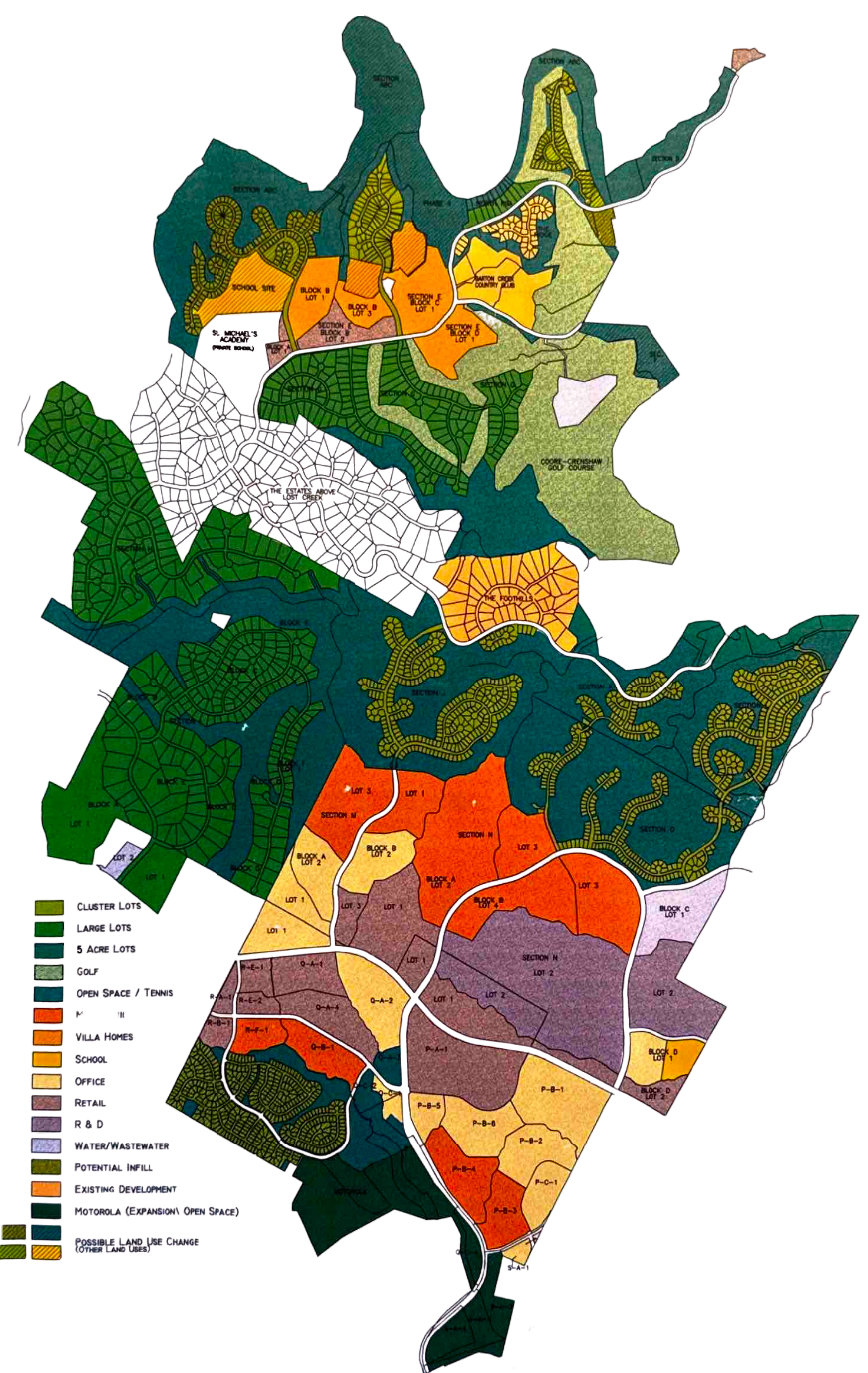
Original Barton Creek Masterplan Map
Why Now? The Texas Market and the Time to Act
With major metros approaching build-out and land costs rising, the Texas market is signaling a shift: rural land is now where future value will be created. Whether for residential, mixed-use, or amenity driven projects, the ability to plan comprehensively, early, and collaboratively is the competitive edge developers need.
More than ever, investors and planners must think holistically. Jurisdictional complexity, water management, slope realities, utility coordination. These are not afterthoughts; they are fundamentals that shape long-term outcomes.
How LSI Can Help
At LSI, our multidisciplinary teams, spanning planning, architecture, landscape architecture, and interiors, work together from the start to help developers and landowners unlock the full potential of rural property. We believe that the best communities are rooted in smart strategy, grounded in environmental understanding, and elevated through design excellence.
If you’re evaluating rural land or preparing to make decisions about your next investment, now is the time to look before lines are locked.